 Lie to Me, which debuted in Jan of 2009, is a crime drama with a twist that has become a pleasantly unexpected hit. The show involves Dr. Cal Lightman (the Oscar-nominated character actor Tim Roth) and his team of human lie detectors who use the science of microexpressions to determine the veracity not only of their subjects, but often of the clients and agencies that have retained their services. Much of the show is formulaic, along the lines of House, with sexual and psychological tensions among the players bridging the plots of the otherwise largely self-contained episodes. All the usual politically correct stereotypes and cliches are there, the misunderstood Muslim, the hooker with the heart of gold, the farmer with a tractor bomb. But the show's gimmick, the scientists' ability to detect lies, means that the writers are always dealing with deeply held values worth lying about. You can focus on the drama and disregard the not always so subtle moralizing. The clip below, where the unpaid intern and loose cannon Eli serenades some kids to keep them calm during a bomb threat is maybe not the most riveting, but in context, it was one of the more memorable scenes in recent scripted television. You can and should catch Lie to Me at Hulu or elswhere and monday nights on Fox. Enjoy also the voice of Felicia Day, here a school teacher, also known to many as Penny, the love interest of Neil Patrick Harris from Joss Whedon's cult hit, Dr. Horrible's Sing-Along Blog.
Showing posts with label drama. Show all posts
Showing posts with label drama. Show all posts
Monday, December 14, 2009
Lie to Me "White Lie"
Lie to Me, which debuted in Jan of 2009, is a crime drama with a twist that has become a pleasantly unexpected hit. The show involves Dr. Cal Lightman (the Oscar-nominated character actor Tim Roth) and his team of human lie detectors who use the science of microexpressions to determine the veracity not only of their subjects, but often of the clients and agencies that have retained their services. Much of the show is formulaic, along the lines of House, with sexual and psychological tensions among the players bridging the plots of the otherwise largely self-contained episodes. All the usual politically correct stereotypes and cliches are there, the misunderstood Muslim, the hooker with the heart of gold, the farmer with a tractor bomb. But the show's gimmick, the scientists' ability to detect lies, means that the writers are always dealing with deeply held values worth lying about. You can focus on the drama and disregard the not always so subtle moralizing. The clip below, where the unpaid intern and loose cannon Eli serenades some kids to keep them calm during a bomb threat is maybe not the most riveting, but in context, it was one of the more memorable scenes in recent scripted television. You can and should catch Lie to Me at Hulu or elswhere and monday nights on Fox. Enjoy also the voice of Felicia Day, here a school teacher, also known to many as Penny, the love interest of Neil Patrick Harris from Joss Whedon's cult hit, Dr. Horrible's Sing-Along Blog.
Thursday, December 18, 2008
Bogart & Hepburn "The African Queen"
 The African Queen is, perhaps, a flawless movie. Directed by John Huston, filmed on location in Africa, starring Katherine Hepburn as the naive missionary Rose Sayer and Humphrey Bogart, who won his only Oscar for his part, as steamboat captain Charlie Allnut, the 1951 film portrays their escapades escaping from German occupied Tanganyika during the First World War. (Bogart and Lauren Bacall were newly married. Bacall accompanied Bogart on the shoot and took home movies.) The African Queen entertains on several levels. It succeeds as adventure, drama, character study and love story.
  Rose and her brother Samuel are lone Protestant missionaries in a remote native village visited monthly by captain Allnut, a scrappy "Canadian" (he has a New York accent) expatriate and alcoholic. Charlie warns them that war has broken out, and that the Germans are coming. Doing God's work, they choose to stay on. The Germans beat Samuel, and he dies from the shock. Rose relents, and after Charlie buries her brother the survivors set off down river for civilization. They face a series of adventures against man and nature. when all seems lost they emerge on lake Tanganyika only to face the Luisa, a German gunboat built on the lake and commanding its waters.
 While much of the film consists of discreet episodes, such as the famous encounter with leeches, and Rose's learning what it is to be a woman as she climaxes riding the rapids, unity is provided by the interaction of this couple thrown together by adversity. She inspires him to overcome his vulgar vices, he inspires her to overcome her Christian virtues. We come to care deeply about the couple as they come to care about each other. Just as the Luisa runs a circuit on the lake, the movie comes full circle, and ends with the heros blown out of the frying pan, and into the water.
This movie should be a part of your video library. You can buy it or rent it or watch it here in full on YouTube:
Friday, November 14, 2008
A Good Woman: "Lady Windermere's Fan"
 The ancients held that the happiness of men is equal to the happiness of the gods, that it admits of no degree. One wonders if this standard applies to works of art? Is any truly good play just as perfect as any other? Oscar Wilde's "Lady Windermere's Fan" would sorely test that notion, for although it is, in its own way perfect, it would also, I have to think, admit of improvement. Let me explain why this play is so satisfying, yet so frustrating.
Read here an extract from the opening dialog of the play, available in full at the Gutenburg Project. Lady Windermere, married a year, in love, and newly a mother, with an acquaintance, Lord Darlington, who has not yet openly revealed that he is madly in love with her:
"Oh, nowadays so many conceited people go about Society pretending to be good, that I think it shows rather a sweet and modest disposition to pretend to be bad. Besides, there is this to be said. If you pretend to be good, the world takes you very seriously. If you pretend to be bad, it doesn’t. Such is the astounding stupidity of optimism."
"Don’t you want the world to take you seriously then, Lord Darlington?"
"No, not the world. Who are the people the world takes seriously? All the dull people one can think of, from the Bishops down to the bores. I should like you to take me very seriously, Lady Windermere, you more than any one else in life."
..."I think we’re very good friends already, Lord Darlington. We can always remain so as long as you don’t -"
"Don’t what?"
"Don’t spoil it by saying extravagant silly things to me. You think I am a Puritan, I suppose? Well, I have something of the Puritan in me. I was brought up like that. I am glad of it. My mother died when I was a mere child. I lived always with Lady Julia, my father’s elder sister, you know. She was stern to me, but she taught me what the world is forgetting, the difference that there is between what is right and what is wrong. She allowed of no compromise. I allow of none."
"My dear Lady Windermere!"
"You look on me as being behind the age. - Well, I am! I should be sorry to be on the same level as an age like this."
"You think the age very bad?"
"Yes. Nowadays people seem to look on life as a speculation. It is not a speculation. It is a sacrament. Its ideal is Love. Its purification is sacrifice."
"Oh, anything is better than being sacrificed!"
"Don’t say that."
"I do say it. I feel it - I know it."
 Darlington is a charming wit and we sympathize with his rejection of conventional hypocrisy. As the plot develops, we learn from Darlington that Lord Windermere has been fraternizing with a Mrs. Erlynne, (here as played by Helen Hunt,) a woman of questionable reputation. Darlington, an honorable and not unforthright man suspects that Lady Windermere will find herself betrayed, and makes it clear that he intends to "be there for her" when she needs him. Later that evening, when Mrs. Erlynne mortifies Lady Windermere by showing up as her husband's guest at Lady Windermere's party, Darlington repeats his offer, explicitly and urgently:
Lady Windermere: "Yes. Her coming here is monstrous, unbearable. I know now what you meant to-day at tea-time. Why didn’t you tell me right out? You should have!"
"I couldn’t! A man can’t tell these things about another man! But if I had known he was going to make you ask her here to-night, I think I would have told you. That insult, at any rate, you would have been spared."
"I did not ask her. He insisted on her coming - against my entreaties - against my commands. Oh! the house is tainted for me! I feel that every woman here sneers at me as she dances by with my husband. What have I done to deserve this? I gave him all my life. He took it - used it - spoiled it! I am degraded in my own eyes; and I lack courage - I am a coward!"
"If I know you at all, I know that you can’t live with a man who treats you like this! What sort of life would you have with him? You would feel that he was lying to you every moment of the day. You would feel that the look in his eyes was false, his voice false, his touch false, his passion false. He would come to you when he was weary of others; you would have to comfort him. He would come to you when he was devoted to others; you would have to charm him. You would have to be to him the mask of his real life, the cloak to hide his secret."
"You are right - you are terribly right. But where am I to turn? You said you would be my friend, Lord Darlington. - Tell me, what am I to do? Be my friend now."
"Between men and women there is no friendship possible. There is passion, enmity, worship, love, but no friendship. I love you -"
"No, no!"
"Yes, I love you! You are more to me than anything in the whole world. What does your husband give you? Nothing. Whatever is in him he gives to this wretched woman, whom he has thrust into your society, into your home, to shame you before every one. I offer you my life-"
"Lord Darlington!"
"My life - my whole life. Take it, and do with it what you will. . . . I love you - love you as I have never loved any living thing. From the moment I met you I loved you, loved you blindly, adoringly, madly! You did not know it then - you know it now! Leave this house to-night. I won’t tell you that the world matters nothing, or the world’s voice, or the voice of society. They matter a great deal. They matter far too much. But there are moments when one has to choose between living one’s own life, fully, entirely, completely - or dragging out some false, shallow, degrading existence that the world in its hypocrisy demands. You have that moment now. Choose! Oh, my love, choose."
"I have not the courage."
"Yes; you have the courage. There may be six months of pain, of disgrace even, but when you no longer bear his name, when you bear mine, all will be well. Margaret, my love, my wife that shall be some day - yes, my wife! You know it! What are you now? This woman has the place that belongs by right to you. Oh! go - go out of this house, with head erect, with a smile upon your lips, with courage in your eyes. All London will know why you did it; and who will blame you? No one. If they do, what matter? Wrong? What is wrong? It’s wrong for a man to abandon his wife for a shameless woman. It is wrong for a wife to remain with a man who so dishonours her. You said once you would make no compromise with things. Make none now. Be brave! Be yourself!"
"I am afraid of being myself. Let me think! Let me wait! My husband may return to me."
"And you would take him back! You are not what I thought you were. You are just the same as every other woman. You would stand anything rather than face the censure of a world, whose praise you would despise. In a week you will be driving with this woman in the Park. She will be your constant guest - your dearest friend. You would endure anything rather than break with one blow this monstrous tie. You are right. You have no courage; none!"
"Ah, give me time to think. I cannot answer you now."
"It must be now or not at all."
"Then, not at all!"
"You break my heart!"
"Mine is already broken."
"To-morrow I leave England. This is the last time I shall ever look on you. You will never see me again. For one moment our lives met - our souls touched. They must never meet or touch again. Good-bye, Margaret."
 And of course, she breaks our hearts too! How could she not go with this man, this man willing to suffer all to gain her, to face the world's scorn for true love? But herein lies the play. Lady Windermere does not abscond with a man worthy of her love. We are denied the happy ending we expect in the second act. Yet Wilde has a trick up his sleave, a twist of the plot, and he pulls off a happy ending with which we are, in the end, satisfied. Is the satisfaction the same as it would have been had the Lady run off? She does end the play happily. And if all happiness is equal, then we too should be happy. Yet...
 Given our modern view of the Victorian virtues, and especially our knowledge as ominpotent spectators in this play, we can imagine an ending to it other than Wilde's which would satisfy us completely. Yet the play's internal logic is sound. The drama works. Wilde is still a dramatic genius. I am not a dramatist, and while I could imagine a great play with a different ending, I could not write it. I do not know if anyone could. But that does not matter. This work stands on its own, and stands up very well. And it contains some of Wilde's best humor, which I will not ruin by telling trying to tell any of it here.
 The play is availble in several versions. Scarlet Johansson stars in the most recent remake which goes by the subtitle of the original, "A Good Woman." The BBC television production which is in stock at Netflix is also available in full at YouTube. Here is part one:
Download the text of Lady Windermere's Fan for free at Project Gutenberg.
Thursday, November 13, 2008
Barbara Tuchman "The Guns of August"
 As I have previously argued, World war I, not World war II, is the formative event of our era. Its effects, which include the Second World War are still being played out in Russia, the Balkans and the Middle East.
One of the most famous works on World War I is Barbara Tuchman's Pulitzer Prize-winning book The Guns of August. This work deals with the circumstances and events leading up to the outbreak of the First World War and the stalemate along the Western Front that ensured a war of attrition settled only by the historically contingent and by no means inevitable intervention of the U.S. in 1917.
Tuchman's book is excellent not only as history, but also as analysis and even as drama. Not a work of art, its artistic touches include grand aphoristic language and a sense of suspense that reads as much like narrative fiction as it does a clinical account.
 Neither the actual outbreak nor the course of the war was predetermined. Even up to mobilization the war could have been averted, although, Tuchman argues, the principles often did not see this. Although the reader knows the outcome, through the first half of the book one is kept turning the pages, hoping that war will be avoided. As diplomats and European royalty work sometimes diligently and sometimes fecklessly to achieve some accomodation, others argue that once the wheels are in motion it would be suicide to attempt a delay of action. The Kaiser is shown as too week to avoid a war (one that he both feared and longed for) as well as too conflicted to win it. The effect of Bristish diplomacy was to support France well enough morally that she would not seriously seek to avoid war with Prussia, but not well enough materially to break the German lines once that war broke out. "No more distressing moment can ever face a British government than that which requires it to come to a hard, fast and specific decision," says Tuchman.
 One particularly tragic event that Tuchman documents is the bombardment of the Belgian city of Louvain and the destruction of its university library, the oldest in Europe, with the loss of countless unique treasures. Cardinal Désiré Mercier, author of the Manual of Modern Scholastic Philosophy would arise as a hero of the Belgian resistance and of civilzed Europe.
This best-seller has been in print continuously since its publication in 1962. Tuchman's interpretation has influenced historians and the work played a pivotal role in the Kennedy Administration's handling of the Cuban Missile Crisis. Read it as drama, as history, and as a book of ideas.
Pictured are the iconic "you country needs you" poster with Lord Kitchener, killed in WWI, The Kaiser in his warlord costume and the ruins of the library of Louvain University.
Friday, October 31, 2008
"Romeo is Bleeding" Femmes Fatales I
 Conflict, says Ayn Rand, is the essence of plot. A plot requires struggle. Man can struggle with nature, with himself, and with other men. A struggle with nature provides a simple, one-sided plot. There is no psychological element, no conflict of human values in such a struggle. A struggle with oneself can be very dramatic, but it affords limited scope unless it is played out in the context of a wider struggle with others. It is in conflict with others that the widest range of plot developments are available. And one of the most popular, if not profound, scenarios for a dramatic plot is the crime story. Inherent in a crime story is the conflict between the criminal and his victim, necessarily with opposing interests.
The femme fatale is a particularly interesting type of character. In the crime story with a femme fatale we have not only the criminal element, with its dimension of good versus evil, we also have a shared romantic interest between the hero and the villain, as well as a conflict in the hero's values. If the hero has a love interest in the villain, then he must struggle "with" her while struggling against her. He may want to love her, but have to kill her. This leads to an internal struggle within the her which allows the dramatist to explore the hero's motivations and to develop his character.
 The first femme fatale movie that I would like to examine is Romeo is Bleeding with two of my favorite actors, Gary Oldman (Jack Grimaldi) and Lena Olin (Mona Demarkov). Grimaldi is a cop on the take, working for the NYPD and the Italian Mafia. He has a wife, (Annabella Sciorra) a mistress (Juliette Lewis) and several hundred thousand in cash buried in his back yard. The mob hires him to kill Demarkov, who is being held by the police in a Brooklyn safe-house, but instead, she seduces him and he is found by his colleagues in a compromising position.
Demarkov is a case study in Ayn Rand's dictum that in a struggle between criminals, where the initiation of force determines the mode of interaction, the more ruthless will win. While Jack wants to live a life of crime while keeping the benefits of middle-class domesticity, Demarkov is fully depraved and uncompromisingly brutal. A succubus (she literally ends up sitting on Grimaldi's chest in almost all of their indoor scenes) she combines intelligence and ravishing beauty with the soul of a psychopath. She taunts Jack with the possibility of a partnership. Mona has her charms. She is exotic, brilliant, glamorous, and seems fully self-assured. But when she finally tells Jack of her first "love," and how she left his body on the beach where they had their one encounter, we see that Grimaldi's hope for a possible match is nothing more than fatal wishful thinking.

This fast-paced and very sytlized movie while not gorey in the sickening manner of a horror film, is incredibly violent, so much so as to be over the top. Yet, as it always furthers the plot, the brutality is not gratuitous. We see Grimaldi strangled, bloodied and maimed. Demarkov is shot and loses a limb. Mob Boss Don Falcone (Roy Scheider) gets his comeuppance in a darkly humorous scene.

It is Lena Olin's sultry black widow performance that has made this movie a cult classic. In a climactic scene, where Demarkov has captured and handcuffed Grimaldi to a bed, baring her prosthetic arm, asks as she mounts him, "with or without?" The answer is without.
For movie stills, see http://lenaolin.net/romeo.html
Here is the theatrical trailer:
Read Femmes Fatales, Part II
Friday, October 24, 2008
Ian McKellen "Richard III"
 Shakespeare's Richard III will do all and lose all to win the crown he so briefly possesses. It seems the real-life king did murder his two nephews to gain the throne uncontested. But Shakespeare allows us to sypmathize with his stagecraft villian, who addresses us as a friend and wittliy defeats all his opponents but the last. Unlike MacBeth, whom fate and his wife conspire to make a villain, Shakespeare's Richard III, out of jealousy and hatred for the joy of others, resolves in his opening soliloquy:
"And therefore, since I cannot prove a lover,
To entertain these fair well-spoken days,
I am determined to prove a villain
And hate the idle pleasures of these days.
Plots have I laid...
To set my brother Clarence and the king
In deadly hate the one against the other..."
Ian McKellen's 1995 production of Richard III, also starring Annette Benning, Maggie Smith, and Robert Downey Jr. and available in DVD format, is one of the best movie adaptations in the genre. Swift and suspenseful, yet lush and poetic, the story is well-adapted to a 1930's setting. The language, well illustrated by the action, is easily accesible to the popular audience. The film bears repeated watching. Much of the play has become the common heritage of the Anglosphere. This play should also be a part of your library.
Much of the play, including the opening soliloquy is available on YouTube. Here is the trailer:
Thursday, October 23, 2008
The Little Girl Who Lives Down The Lane
 Jodie Foster's immortal place in American culture is, of course, unquestioned. Even today at 50 she regularly tops Angelina Jolie in polls of Ayn Rand fans for their fantasy cast of Dagny in Atlas Shrugged. Strong, beautiful, self-assured, no contemporary star outshines the lead of such films as Contact, Nell, The Accused and Silence of the Lambs. Foster began work as a child actress in 1968 and by 1975 she starred in two feature films, the very different Freaky Friday and Little Girl who Lives down the Lane. She does play an smart and independent child in each role. Freaky Friday, a Disney film, has been remade several times. But there is only one "Down the Lane." I enjoyed the first, I fell in love with her when I saw the second.
 In this film, an homage to film noir, Foster plays a gifted child living alone in a rented New England home. Her nosey landlady Mrs. Hallet and the landlady's pedophile son Frank (Martin Sheen) question her on the absence of her father and otherwise threateningly intrude on her privacy. Foster, used to dealing with adults as an equal, faces a crisis when her landlady dies in a suspicious accident. Foster and her boyfriend hatch a scheme to allay the suspicion of the townfolk. The movie ends with a classic dark resolution of her difficulties with Frank Hallet. This film is a must see both for itself and as a vehicle for Foster. Here is an expository clip from YouTube:
Tuesday, October 21, 2008
Richard Adams "Watership Down"
 Frank Herbert's Dune was rejected by almost twenty publishers. Made into two movies, it is now the best selling science-fiction book of all time. Ayn Rand's Fountainhead was rejected by twelve publishers, and has been made into a movie, sold millions of copies, and was voted second-favorite novel of the 20th Century in Modern Library's reader's poll. Richard Adams' Watership Down was rejected by 13 publishers. It has been adapted for film and television. It is 79th on the Modern Library poll. It has sold more copies than any other novel under the Penguin Books label.
Watership Down is the epic adventure story of Fiver, Bigwig and Hazel, three rabbits whose warren is destroyed and who must brave the threats of men, predators, and a band of rabbits run as a military dictatorship in order to build a home in peace and freedom. A critical success, the novel has been likened to Tolkien's work for its complex back-story including a mythology and an invented language. It has been likened to Homer's Odyssey and Virgil's Aeneid for its plot and epic scope. It is the story of the triumph of bravery and cooperation over submission and force.
While the subject might seem juvenile, the story is written at an adult level and will appeal to all who like a well-plotted adventure with a positive theme and a happy ending. This is one book that no parent will begrudge reading his children.
The 1978 movie adaption is quite faithful to the book. It should, of course, be enjoyed after you have read the novel. It is also available in full on YouTube, here:
Saturday, October 11, 2008
Johnny Guitar & Women on the Verge
 In Pedro Almodovar's Woman on the Verge of a Nervous Breakdown the protagonist Pepa Marcos (Carmen Maura) has just been unceremoniously dumped by her lover and co-worker Ivan (Fernando Guillén) with whom she does voiceover work. Exhausted and about to discover she is pregnant, Pepa takes too many sleeping pills and arrives after her lover has finished a session of dubbing Johnny Guitar, the 1954 classsic western with Joan Crawford and Sterling Hayden.
 "Lie to me. Tell me you've always loved me. Tell me you would have died without me."
 Both movies featue drama and struggle between women slinging guns as they ride. Johnny Guitar portrays murder, while in Women on the Verge at worst a bed is burnt to death. With music, color and melodrama the two make an interesting pair. Women on the Verge is Almodovar's best, and Crawford was never better than in Johnny Guitar. Here a few clips from each. My apolgies for the lack of subtitles for the Spanish.
"Lie to Me" Johnny Guitar
Pepa's Dub Session (Pepa oversleeps, and misses Ivan's break-up call. The Doctor tells her she's pregnant. Pepa does her dubs. She calls Ivan from work, but gets his wife, who having just left the insane asylum, thinks she's still young.)
"The Piano Scene" Johnny Guitar
Pepa, packing Ivan's things, and "sick of being good" forgets she shouldn't be smoking, and burns the bed, to Rimsky-Korsakov's Scheherazade
Tuesday, October 7, 2008
"Solea" from Almodóvar's "Flower of my Secret"
 Unrequited love, a style of dance that combines the grace of ballet and the energy of tap...is it Rand's lost novel To Lorne Dieterling? No, it's The Flower of My Secret, the story of a passionate writer looking for just a little bit more out of life. One night, at a dance recital where Miles Davis and Pedro Almodovar intersect, she finds it.
 As with many of his films, distinctive for their melodramatic plots and vibrant color, Pedro Almodóvar's 1995 Flower of My Secret (La flor de mi secreto) also features a dramatic musical performance however loosely tied to the plot structure. This movie tells the story of Leocadia, (Marisa Paredes) picured here with her elderly mother and her "crab-faced" sister, a writer of popular romance novels, who looses one love, and, in trying to switch to a more profound style of writing, finds a better. This is one of Almodóvar's best films, if one of his least outlandish. One of the highlights is Joaquín Cortés and Manuela Vargas's interprative/flamenco dance performance to Miles Davis' "Solea" (Sketches of Spain) which can be seen here:
Here is the trailer:
Sunday, September 28, 2008
Almodóvar "Tie Me Up, Tie Me Down"
 Tie Me Up, Tie Me Down (Spanish Átame) was one of Pedro Almodóvar's most successful films, even given its original X rating upon its release, which sparked a lawsuit and the development of the NC17 rating as an alternative. The film depicts the story of Ricky (Antonio Banderas) a recently released mental patient and Marina (Victoria Abril) his ex-porn star love, whom he kidnaps and keeps tied up until she comes to realize his love for her. Considered risqué and by some feminists highly objectionable (one wonders if they saw the film) the film is a love story and features very little explicit nudity. The films joyous sense of life is excellently expressed by the cast and Almodóvar's vibrant signature direction. Enjoy this brief scene where Marina's sister Lola (Loles León) sings and dances at the cast party for Marina's latest film.
Friday, September 26, 2008
Noels Coward's "Brief Encounter"
 Experience Sergei Rachmaninoff, David Lean, Celia Johnson & Trevor Howard all together on one stage in Noel Coward's 1945 hit Brief Encounter.
An express pulls into the station. From our angle at the level of the platform the train slashes the shot diagonally in two. Strains of Rachmaninoff's 2nd Piano Concerto rise as the opening score.
Celia Johnson's face conveys incredible emotion, her eyes alone speaking more than words ever could. Trevor Howard is, as ever, the essential English Gentleman.
Both married, each struggles with the decision as to whether to consummate the affair. As he does the crossword Johnson's character Laura offhandedly mentions the truth to her husband that she has been seeing a strange man. He responds "Good for you."
This well written story, from a Noel Coward play, sceenwritten and produced by him and shot by the director of Lawrence of Arabia and Doctor Zhivago manages to maintain 85 minutes of taut suspense where all the action is set in drawing rooms, railway café stations, and in internal dialogs. And for a black-and-white film set mostly in small London locals, the film is gorgeous.
From TCM: "To many, Brief Encounter may seem like a relic of more proper times--or, specifically, more properly British times--when the pressures of marital decorum and fidelity were perhaps more keenly felt. In truth, David Lean's fourth film remains a timeless study of true love (or, rather, the promise of it), and the aching desire for intimate connection that is often subdued by the obligations of marriage. And so it is that ordinary Londoners Alec (Trevor Howard), a married doctor, and contented housewife Laura (Celia Johnson) meet by chance one day in a train station, when he volunteers to remove a fleck of ash from her eye (a romantic gesture that, perhaps, inspired Robert Towne's "flaw in the iris" scene in Chinatown)."
Here is the trailer:
I recommend this film without qualification.
Thursday, September 25, 2008
Luz Casal "Piensa en mi"
 Here is a clip of Luz Casal singing Piensa en mi ("Think of me") from the movie "High Heels" (Tacones Lejanos) by Pedro Almodóvar, starring Marisa Paredes as a self-centered night club singer and Victoria Abril as the daughter she abandoned for her love and career. Casal has an incredible powerful and expressive voice. The film, a murder mystery, love story, and exploration of mother-daughter relationships is not Almodóvar's best, although it is certainly worth watching if you are a fan, or enjoy this style of music.
Friday, September 5, 2008
Dune 1984 (Extended Edition)
 Starring: Kyle McLachlan, Francesca Annis, Jose Ferrer, Sian Phillips
Director: David Lynch
Dictators named Saddam and Vladimir, poisoning,assassination, suicide warriors and Jihad, a vital resource found only in dessert sands...sound familiar? But this is not from the headlines,but rather from Frank Herbert's classic novel Dune. Herbert was decades, if not milennia ahead of his time.
The 1984 release of the movie adaptation was long awaited, and a disappointment to many fans, suffering in many of the same ways that The Fountainhead did, as being too rich and too long a story for screen adaptation. Yet what did appear on screen in 1984 was faithful in large part to the spirit of the original novel.
Now an extended version, with some 40 minutes of footage cut from the original is available as an import or from NETFLIX in all DVD formats.
This release begins with some exposition done by charcoal storyboard, and there is narration which could have either been better done or omitted. But the added visuals and the cut-out plot elements will make this version a must-see for anyone who enjoyed the original.
The care that was put into designing the sets for the interior shots, done by H.R.Giger of Aliens fame, is wonderful. Much of this was lost from the original theatrical release. Likewise, the extra-widescreen version of this release makes the viewing experience much more enjoyable.
If you liked the first release with all its flaws, this is a must-see.
Wednesday, September 3, 2008
Umberto Eco "The Name of the Rose"
 Upon rereading Umberto Eco's The Name of the Rose I am struck by the obvious influence of Jorge Luis Borges on the work. When I first read the book in 1984 I was not aware of Borges, and had only just put down my first reading of Atlas Shrugged. The book itself is presented, in Borgesian manner, as a reconstructed text based upon a partial translation of a now lost and otherwise undocumented manuscript from the late Middle Ages. The plot concerns the investigation of a murder mystery set in a fictional monastery renowned for its unique library, the largest collection of books in Christian Europe, supposedly holding works of Aristotle lost to modernity. The characters are primarily scribes or other intellectuals. Yet, unlike much of Borges' esoteric works, this novel is not merely a curiosity, an intellectual insider's joke, but a true intellectual adventure story rewarding on many levels.
The hero, William of Baskerville, a Franciscan brother, is a champion of reason who has abandoned his position with the inquisition. He saw that institution not as a means of pursuing the truth, but as the use of force to compel confessions, which, even when they implicate guilty parties, are an affront to God's justice and his gift to man of the intellect. Brother William is a follower of Thomas Aquinas, a student of Roger Bacon, and a proponent of the scientific method, although he does not, of course, explicitly identify his investigations as such.
 The story is told in retrospect by the Benedictine monk Adso of Melk. At the time of the story Adso was in his teens but he writes his tale as a dying man who promises to "tell the facts without interpretation" so that the signs he conveys will speak for themselves, allowing other wiser men in the future to draw their own interpretations. Adso is a mystic, and not an intellectual, but he admires William as a sincere instrument of justice, better than he.
The novel is steeped in the intricacies of pre-reformation Catholic theology; the debates among the great Scholastic thinkers such as Abelard, Occam, Duns Scotus and the other thinkers at the universities of Paris and Oxford, the details of monastic life, the methods of copying and illuminating texts, the herbal lore of the high mediaeval period, the particulars of numerology and its place even in architectural symbolism, and of course, as one would expect in the tradition of Borges, a great deal of irony, symbolism, abstruse academic references, and the ever present contrast between substance and form, essence and accident, genus and species, and exemplar and type. We hear Latin on most every page, verse and speech in Middle English, and contemporary German, French, Italian, Spanish and Provencal. One character, Salvatore, is so deformed that not only does he physically resemble a monster sewn together from the parts of different corpses, his speech is an almost unintelligible farrago of words from Latin and all the vernacular tongues which he has encountered. Listening to him can be as fascinating (or as disconcerting) as listening to a conversation on the NYC subway between a mixed family of a Puerto Rican and an Orthodox Russian Jew whose children go to public school - English, Spanish, Yiddish, Russian, Hebrew and Ebonics all in one sentence.

Adso himself religiously promises on the first page of his memoirs not to relay "mere" visual details such as the expressions of speakers or the appearance of their faces, as they "will be long dead" by the time we read his description of events. This is an ironic promise which, thankfully for us, he breaks almost immediately. While some of the descriptions of architectural, sacrimonial and mythological details can become tedious, the book is visually vivid and his concretizations make the setting and characterizations immediate and lifelike.
While the murder mystery is the prime mover of the story, it serves as an excuse for many interesting digressions: lengthy discussions of Papal, local and Imperial politics, the details of everyday monastic life, not only spiritual, but also scribal and mundane, such as the details of animal slaughter and food preparation; the tensions between various factions within the Church advocating poverty versus temporal power, faith versus reason, tradition and the new learning, the tensions between the old feudal political and economic power of the monastic centers and the Pope versus the rising market power of the new trade centers and the monetary power of the princes.
 Much of the content of this amazing and brilliant work is religious, specifically Catholic in substance. There is lengthy examination of religious themes such as temptation, sin, and penitence, the nature of God and Satan, heaven and hell, prophesy, heresy, schism and persecution, the Antichrist and the Second Coming and personal salvation through works and grace. This contemplation is counterposed to the main action of the hero, a true scholar and scientist who uses reason and observation, not suspicion and circular justifications, to solve his mystery and save much more.
This book has been made into a very satisfying movie. Yet, as with any great work of art, its adaptation into that medium has required that much be simplified, reduced or omitted. The movie retains the bare bones of the actual murder mystery, and makes Adso's love interest (Adso was Christian Slater's first movie role) much more important than in the novel. On film, cliche often replaces depth. In the novel, the first charcter to die is a young initiate who has had a homosexual encounter with another initiate. In the movie he is not, as in the book, seduced by another young man, but by an obese, leering old lecher. While the movie is a few hours diversion, this novel is an engrossing immersion in and education about a world of which many of us know little, but a world which is much closer in time than one might think. In a fictional monastery in the mountains of Italy in an age which many call dark we literally see the power of reason, the place of philosophy, and the fight of men of good will to preserve the light amidst that darkness.
Tuesday, September 2, 2008
Kim Novak in "Bell, Book & Candle"
This 1958 romantic comedy stars Kim Novak as a witch in modern Manhattan who does the one thing a witch must not do, fall in love with a mortal. This light-hearted work is one of Novak's best, although her romantic lead, Jimmy Stewart, is poorly cast for the part.

Novak's Gillian Holroyd has heard of the old wives' tales that say a witch can't ever cry, or fall in love, without losing her powers. After a whirlwind romance with Stewart, Novak finds out that this time it's more than just a case of "hot blood," it's for real. Ernie Kovacs, a hack writer and drunk who thinks he knows about witchcraft is initiated into the "lifestyle" by Novak's brother, played by Jack Lemmon. The movie is visually lush and features Novak at her most alluring. The nightclub encounter where Novak steals Stewart out from under his fiancée's nose is a classic, a barefoot Novak at her best. Camille Paglia has described the movie, which she sees as a metaphor for the hidden love lives of the homosexuals of the 1950's, as one of her all-time favorites. This light-hearted fantasy pleases on many levels, and bears repeated viewings.
This not-very-impressive trailer undersells the movie, but I'll include it in any case.
Novak's Gillian Holroyd has heard of the old wives' tales that say a witch can't ever cry, or fall in love, without losing her powers. After a whirlwind romance with Stewart, Novak finds out that this time it's more than just a case of "hot blood," it's for real. Ernie Kovacs, a hack writer and drunk who thinks he knows about witchcraft is initiated into the "lifestyle" by Novak's brother, played by Jack Lemmon. The movie is visually lush and features Novak at her most alluring. The nightclub encounter where Novak steals Stewart out from under his fiancée's nose is a classic, a barefoot Novak at her best. Camille Paglia has described the movie, which she sees as a metaphor for the hidden love lives of the homosexuals of the 1950's, as one of her all-time favorites. This light-hearted fantasy pleases on many levels, and bears repeated viewings.
This not-very-impressive trailer undersells the movie, but I'll include it in any case.
Saturday, August 23, 2008
"Hate Can Be a Very Exciting Emotion"
Quick, which iconic 1940's film noir features a thrid-world nightclub owner, Nazis, a love affair gone wrong, a fateful airplane trip and an iconic theme song? If you said Casablanca, then you should have said Gilda, the best film of the 1940's, the one where the hero does not achieve greatness through sacrifice.
 Directed by Charles Vidor, Gilda stars Glenn Ford as Johnny Farrell, a handsome, streetwise adventurer and romantic lead who "makes his own luck." Having just ended a relationship, our hero moves to Buenos Aires as the war in Europe is coming to a close. He meets Ballin Mundson, a German expatriate with a dueling scar, who rescues him from a mugging in the opening scene. The classy and witty dialog and reparté is reminiscent of such films as the screwball comedy His Girl Friday, and the romantic drama To Have and Have Not. Originally cast for Humphrey Bogart who turned the role down, Glenn Ford's Johnny becomes the right hand man at Mundson's illegal Buenos Aires casino. Mundson, driven and unhappy, goes away leaving Johnny in charge. He returns, grinning like a fool, wed to Rita Hayworth's glorious Gilda, one of the most famous screen roles ever played. Unbeknownst to Mundson, Johnny and Gilda have a past. The three toast "Disaster to the wench that did our Johnny wrong," and murder ensues. The film is well plotted, and slyly written. Hayworth is at her best, singing in the nightclub, and, by removing just one glove, performing perhaps the most seductive striptease in cinematic history. I first saw this movie a year ago, and have watched it more than six times since. It cannot recommend it more highly. Hayworth also shines in The Lady from Shanghai, written and directed by, and starring Orson Welles, who was married to Hayworth at the time. Sadly, Hayworth found it impossible to live up to the fantasy ideal of Gilda in her life off stage. After several failed marriages, she complained that men "went to bed with Gilda, and woke up with me."
What all the fuss is about:
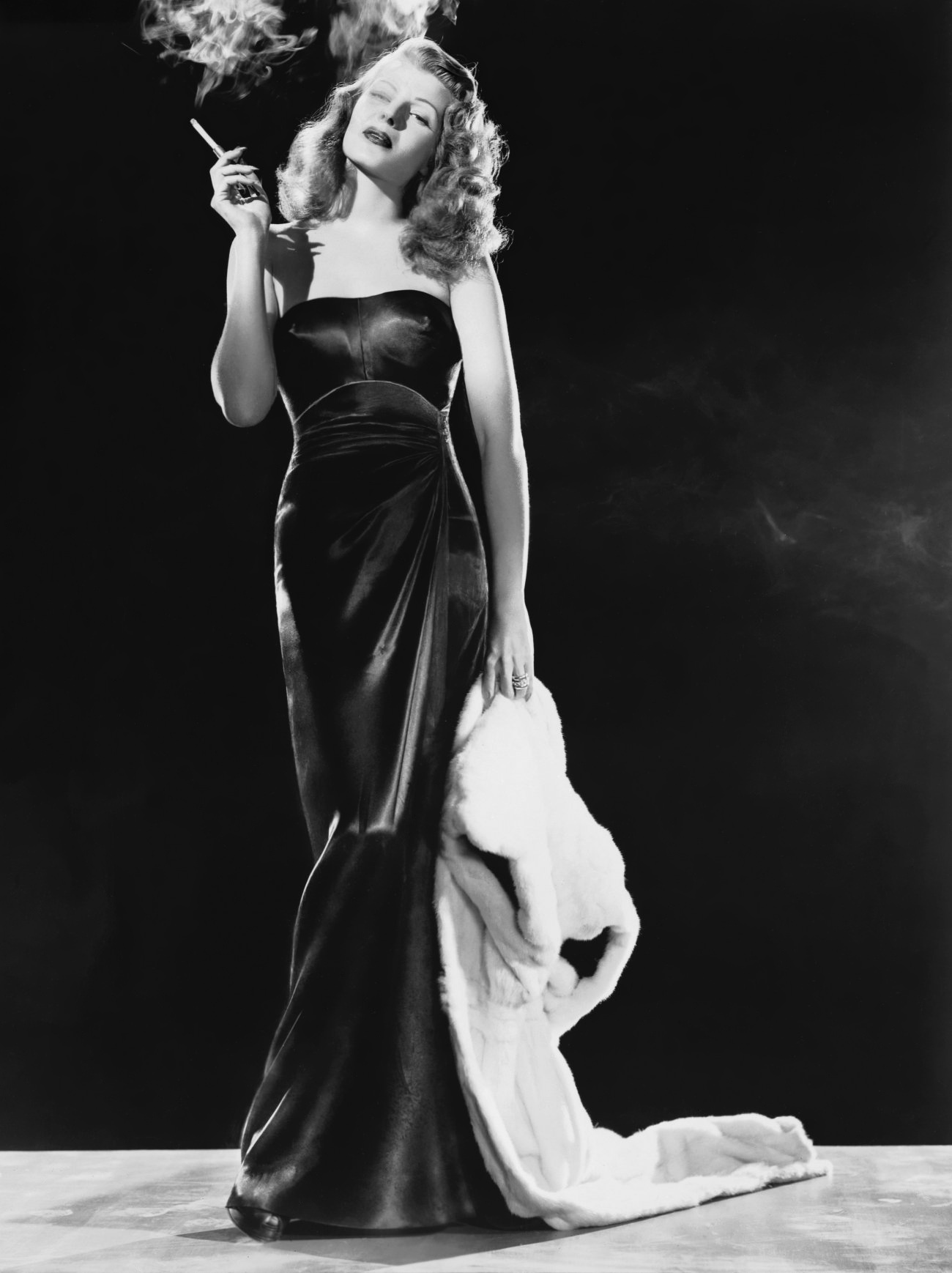 Directed by Charles Vidor, Gilda stars Glenn Ford as Johnny Farrell, a handsome, streetwise adventurer and romantic lead who "makes his own luck." Having just ended a relationship, our hero moves to Buenos Aires as the war in Europe is coming to a close. He meets Ballin Mundson, a German expatriate with a dueling scar, who rescues him from a mugging in the opening scene. The classy and witty dialog and reparté is reminiscent of such films as the screwball comedy His Girl Friday, and the romantic drama To Have and Have Not. Originally cast for Humphrey Bogart who turned the role down, Glenn Ford's Johnny becomes the right hand man at Mundson's illegal Buenos Aires casino. Mundson, driven and unhappy, goes away leaving Johnny in charge. He returns, grinning like a fool, wed to Rita Hayworth's glorious Gilda, one of the most famous screen roles ever played. Unbeknownst to Mundson, Johnny and Gilda have a past. The three toast "Disaster to the wench that did our Johnny wrong," and murder ensues. The film is well plotted, and slyly written. Hayworth is at her best, singing in the nightclub, and, by removing just one glove, performing perhaps the most seductive striptease in cinematic history. I first saw this movie a year ago, and have watched it more than six times since. It cannot recommend it more highly. Hayworth also shines in The Lady from Shanghai, written and directed by, and starring Orson Welles, who was married to Hayworth at the time. Sadly, Hayworth found it impossible to live up to the fantasy ideal of Gilda in her life off stage. After several failed marriages, she complained that men "went to bed with Gilda, and woke up with me."
What all the fuss is about:
Friday, August 22, 2008
Barbara Stanwyck 1907-1990 the "Ball of Fire"
 Barbara Stanwyck, for a period during the 1940’s the highest paid actress in Hollywood, (and woman in the U.S.,) was a self-made woman, if ever there was one. Queen of the film noir, Stanwyck was known for playing tough broads, often the girlfriend of a mobster - Night Nurse, Ball of Fire - or a killer herself - Double Indemnity. Having lost her family at a young age, Stanwyck, born Ruby Stevens, grew up in Brooklyn and got her start on stage at age 13. Often described as ashamed of her lack of education, Stanwyck wasn’t all that ignorant. It was she who fought to have Jack Warner produce The Fountainhead, only to lose the part to Patricia Neal at director King Vidor's insistance. While her role in Double Indemnity with Fred MacMurray and Edward G. Robinson is often considered one of her best performances, my favorite so far has been her lead as Sugarpuss O’Shea in Howard Hawks’ 1941 Ball of Fire, written by Billy Wilder. In it she plays a familiar role, the gangster’s moll, and gets to show off her figure and her sultry voice as a nightclub performer. On the lam to avoid a “subpeeny” from the D.A.’s office, she meets Gary Cooper’s professor Potts, a befuddled doctor of English etymology, looking to complete his slang dictionary. This screwball comedy has Stanwyck first dupe and then fall for Cooper, each teaching the other about a part of life which each had been missing. Barbara steals the movie when she sings along to Gene Krupa, performing his virtuoso Drum Boogie, first with him on drums and her to the band, then him on matches and her sotto voce. Stanwyck was an actress often too big for the roles she played. (Her struggle against the constraints of a reality sometimes too small for our dreams was most passionately portrayed in her 1983 swan song, the Thorn Birds.) In Ball of Fire, a comedy with a plot, we see her as cunning, coy, fun and flustered, and always fully woman. When you watch it, keep in mind that Stanwyck didn’t pull her punches, and that she actually broke actress Kathleen Howard’s jaw in a stunt you’ll see on film. Above, Stanwyck as Stella Dallas, Below, from Ball of Fire, and Stanwyck's last on screen performance in The Thorn Birds - immortal!
Drum Boogie, with Krupa & Cooper in Ball of Fire
The Thorn Birds
Sunday, August 3, 2008
"Volver" 2006 Pedro Almodovar
 Growing up in a small Spanish village, Raimunda (Penelope Cruz) and her sister had long heard tales of ghosts, and of the madness visited upon the villagers by the dry East winds. Years before, their parents had died in a fire driven by this wind. Now, returning to bury their long senile and helpless aunt they hear rumours that she had survived with the aid of the ghost of their dead mother Irene (Carmen Maura). Suffering problems of their own, Irene's daughters now become the recipients of her spectral aid.
 This latest of Pedro Almodóvar's works, while superior in many ways to his last two movies, Talk to Her and Bad Education, still suffers from the same flaw they exhibited, a theme largely focused on the exploration of victimhood. Nevertheless, the film is visually brilliant, and the characters, while all victims, do for the most part overcome their travails. The film has what amounts to a happy ending, and does not suffer the morbid perversity of his two prior works. Fans of Almodóvar will want to see this movie if only for his characteristic use of brilliant color which makes each scene a chromatic adventure. Carmen Maura's "return" to the cast of Almodovar will also be a welcome treat for those who remeber her from the halcyon days of Women on the Verge of a Nervous Breakdown. While coherent and, with murder and melodrama, sufficiently interesting to keep one's attention, the story suffers from undeveloped subplots and elements such as drug use, lesbianism, and a dubbed but strikingly beautiful song by Cruz which seem to have been added in simply because these devices are what one expects from an Almodóvar movie.
While described as a comedy, this movie did not once make me laugh, although the scene where Cruz sings "Volver" (return), unaware that her mother's ghost is listening, did move me. And another gratifying scene occurs when one of the supporting characters, dying of cancer, does the right thing on a Spanish version of the Jerry Springer show.
I bought this movie on DVD on the day it was released, and as an Almodóvar fan I enjoyed this film as a return to the form he exhibited in The Flower of My Secret his best work since the excellent Tie me up, Tie me Down (Átame). While certainly worth renting, I cannot recommend that non-afficionados spend their money to purchase this film.
Here is the studio trailer from YouTube:
Monday, July 28, 2008
Download Orson Welles' Mecury Theater for Free
 Orson Welles' Mercury Theater Company (renamed the Campbell Theater Company after Campbell Soup took up its sponsorship) produced the infamous "War of The Worlds" 1938 broadcast, and dozens more, which are available for free here: http://www.mercurytheatre.info/
The following titles are available, about one hour each:
Dracula
Treasure Island
The 39 Steps
Three Short Stories: I'm a Fool, The Open Window, and My Little Boy
Abraham Lincoln
The Affairs of Anatol
The Count of Monte Cristo
The Man Who Was Thursday
The Immortal Sherlock Holmes
Hell on Ice
Seventeen
Around the World in 80 Days
The War of the Worlds
Heart of Darkness / Life with Father
A Passenger to Bali
The Pickwick Papers
Rebecca
A Christmas Carol
Counselor-at-Law
Mutiny on the Bounty
I Lost My Girlish Laughter
Arrowsmith
The Green Goddess
The Glass Key
Beau Geste
Showboat
The Patriot
Private Lives
Wickford Point
Our Town
The Bad Man
Things We Have
Victoria Regina
Peter Ibbetson
Ah, Wilderness
What Every Woman Knows
The Count of Monte Cristo
Algier
Liliom
The Magnificent Ambersons
The Hurricane
The Murder of Roger Ackroyd
The Garden of Allah
Dodsworth
Lost Horizon
Venessa
There's Always a Woman
A Christmas Carol
Vanity Fair
Theodora Goes Wild
The Citadel
It Happened One Night
Mr. Deeds Goes to Town
Dinner at Eight
Only Angels Have Wings
Rabble in Arms
Craig's Wife
Huckleberry Finn
June Moon
Subscribe to:
Posts (Atom)

