
Upon rereading
Umberto Eco's
The Name of the Rose I am struck by the obvious influence of Jorge Luis Borges on the work. When I first read the book in 1984 I was not aware of Borges, and had only just put down my first reading of
Atlas Shrugged. The book itself is presented, in Borgesian manner, as a reconstructed text based upon a partial translation of a now lost and otherwise undocumented manuscript from the late Middle Ages. The plot concerns the investigation of a murder mystery set in a fictional monastery renowned for its unique library, the largest collection of books in Christian Europe, supposedly holding works of Aristotle lost to modernity. The characters are primarily scribes or other intellectuals. Yet, unlike much of Borges' esoteric works, this novel is not merely a curiosity, an intellectual insider's joke, but a true intellectual adventure story rewarding on many levels.
The hero, William of Baskerville, a Franciscan brother, is a champion of reason who has abandoned his position with the inquisition. He saw that institution not as a means of pursuing the truth, but as the use of force to compel confessions, which, even when they implicate guilty parties, are an affront to God's justice and his gift to man of the intellect. Brother William is a follower of Thomas Aquinas, a student of Roger Bacon, and a proponent of the scientific method, although he does not, of course, explicitly identify his investigations as such.

The story is told in retrospect by the Benedictine monk Adso of Melk. At the time of the story Adso was in his teens but he writes his tale as a dying man who promises to "tell the facts without interpretation" so that the signs he conveys will speak for themselves, allowing other wiser men in the future to draw their own interpretations. Adso is a mystic, and not an intellectual, but he admires William as a sincere instrument of justice, better than he.
The novel is steeped in the intricacies of pre-reformation Catholic theology; the debates among the great Scholastic thinkers such as Abelard, Occam, Duns Scotus and the other thinkers at the universities of Paris and Oxford, the details of monastic life, the methods of copying and illuminating texts, the herbal lore of the high mediaeval period, the particulars of numerology and its place even in architectural symbolism, and of course, as one would expect in the tradition of Borges, a great deal of irony, symbolism, abstruse academic references, and the ever present contrast between substance and form, essence and accident, genus and species, and exemplar and type. We hear Latin on most every page, verse and speech in Middle English, and contemporary German, French, Italian, Spanish and Provencal. One character, Salvatore, is so deformed that not only does he physically resemble a monster sewn together from the parts of different corpses, his speech is an almost unintelligible farrago of words from Latin and all the vernacular tongues which he has encountered. Listening to him can be as fascinating (or as disconcerting) as listening to a conversation on the NYC subway between a mixed family of a Puerto Rican and an Orthodox Russian Jew whose children go to public school - English, Spanish, Yiddish, Russian, Hebrew and Ebonics all in one sentence.

Adso himself religiously promises on the first page of his memoirs not to relay "mere" visual details such as the expressions of speakers or the appearance of their faces, as they "will be long dead" by the time we read his description of events. This is an ironic promise which, thankfully for us, he breaks almost immediately. While some of the descriptions of architectural, sacrimonial and mythological details can become tedious, the book is visually vivid and his concretizations make the setting and characterizations immediate and lifelike.
While the murder mystery is the prime mover of the story, it serves as an excuse for many interesting digressions: lengthy discussions of Papal, local and Imperial politics, the details of everyday monastic life, not only spiritual, but also scribal and mundane, such as the details of animal slaughter and food preparation; the tensions between various factions within the Church advocating poverty versus temporal power, faith versus reason, tradition and the new learning, the tensions between the old feudal political and economic power of the monastic centers and the Pope versus the rising market power of the new trade centers and the monetary power of the princes.

Much of the content of this amazing and brilliant work is religious, specifically Catholic in substance. There is lengthy examination of religious themes such as temptation, sin, and penitence, the nature of God and Satan, heaven and hell, prophesy, heresy, schism and persecution, the Antichrist and the Second Coming and personal salvation through works and grace. This contemplation is counterposed to the main action of the hero, a true scholar and scientist who uses reason and observation, not suspicion and circular justifications, to solve his mystery and save much more.
This book has been made into a very satisfying
movie. Yet, as with any great work of art, its adaptation into that medium has required that much be simplified, reduced or omitted. The movie retains the bare bones of the actual murder mystery, and makes Adso's love interest (Adso was Christian Slater's first movie role) much more important than in the novel. On film, cliche often replaces depth. In the novel, the first charcter to die is a young initiate who has had a homosexual encounter with another initiate. In the movie he is not, as in the book, seduced by another young man, but by an obese, leering old lecher. While the movie is a few hours diversion, this novel is an engrossing immersion in and education about a world of which many of us know little, but a world which is much closer in time than one might think. In a fictional monastery in the mountains of Italy in an age which many call dark we literally see the power of reason, the place of philosophy, and the fight of men of good will to preserve the light amidst that darkness.
 Little compares to Ludwig van Beethoven. One of the strangest opinions I've ever heard of Beethoven is that his music is malevolent. He certainly can convey darker themes with his compositions. The Fifth Symphony, with its "Fate knocking at the door" is far from lighthearted. Indeed, Beethoven can be seen as the first Heavy Metal artist, with the booming epic style of his symphonies. Considered a member of the Classical school along with Mozart and Haydn we can hear echoes of Shubert and a foretaste of the Romantics that is absent mostly, say, in Mozart. To make a grossly inadequate analogy for the student of pop music, Beethoven's dramatic range is like Led Zepellin to Mozart's saccharine early Beatles.
 One of my favorite of all classical pieces is Beethoven's Sixth Symphony, "The Pastoral." Composed, rehearsed and debuted along with the more ominous Fifth, The Sixth, with its buoyant mood, provides a perfect complement. The Pastoral Symphony, which is intentionally meant to evoke "recollections of country life" has been famously adapted to two iconic movies of the Twentieth Century. The first is Walt Disney's animated masterpiece Fantasia. The full five movements, performed by Leopold Stokowski directing the Philadelphia Symphony Orchestra, are illustrated with scenes of Greek and European mythology that comprise one of my earliest and most joyful childhood memories.
  The second iconic film usage is in 1973's sci-fi noir, Soylent Green. The fatherly police archivist Sol Roth, (Edward G. Robinson in his last role,) has watched America decay from greatness to mindless rioting and self-delusion. Choosing to die, he patronizes a state-run euthansia clinic. With all the world's wildlife dead, Roth watches images of the countryside and listens to Beethoven's Pastoral as the fatal cocktail takes effect. Of course its use in Soylent Green is darkly ironic. The piece itself conjures no malevolent images, at least nothing worse than a soon-passed summer thunderstorm.
 Frank Herbert's
  Back in 2001 an Indian friend (who had to leave the country after 9-11 when his work visa was not renewed) lent me the movie
  I first heard Umm Kulthum sing in 2000. The "Arab world's most famous and distinguished singer of the 20th century" is an exotic and acquired taste for most Westerners. Her voice wails like a desert wind and booms like a landslide, conveying passion, longing, and betrayal like a Middle-Eastern war. Her weekly concerts, broadcast from Cairo, brought a moment of peace each Friday night until shortly before her death in 1975. Her funeral was attended by 4 million people. According to
  In Pedro Almodovar's
  Both movies featue drama and struggle between women slinging guns as they ride.
  Unrequited love, a style of dance that combines the grace of ballet and the energy of tap...is it Rand's lost novel
  As with many of his films, distinctive for their melodramatic plots and vibrant color, Pedro Almodóvar's 1995 Flower of My Secret (La flor de mi secreto) also features a dramatic musical performance however loosely tied to the plot structure. This movie tells the story of Leocadia, (Marisa Paredes) picured here with her elderly mother and her "crab-faced" sister, a writer of popular romance novels, who looses one love, and, in trying to switch to a more profound style of writing, finds a better. This is one of Almodóvar's best films, if one of his least outlandish. One of the highlights is Joaquín Cortés and Manuela Vargas's interprative/flamenco dance performance to Miles Davis' "Solea" (Sketches of Spain) which can be seen here:
 Created by Joss Whedon (of Firefly and Buffy The Vampire Slayer fame) during the 2008 Writer's Guild strike, this three-act 43 minute musical comedy starring Neil Patrick Harris (of Doogie Hauser fame) as the eponymous evil villain was designed for internet distribution and has earned a well deserved cult following since its release in the Summer of 2008. Dr. Horrible is an evil yet sympathetic underdog determined to get the credit his genius deserves at any cost. He competes unsuccesfully with the bumbling, crude and egotistical Captain Hammer for fame and the love of Penny, a kind-hearted worker with the homeless. The production is both humorous and poignant. We laugh at, yet sympathize with Dr. Horrible in his quest to defeat the undeserving "hero" Captain Hammer. The story ends with a cliff-hanger, and I for one would pay good money to see it resolved. You don't have to pay money to see it the story unfold. Here is the article at
  In
In 
 Experience Sergei Rachmaninoff, David Lean, Celia Johnson & Trevor Howard all together on one stage in Noel Coward's 1945 hit Brief Encounter.
 Here is a clip of Luz Casal singing Piensa en mi ("Think of me") from the movie "High Heels" (Tacones Lejanos) by Pedro Almodóvar, starring Marisa Paredes as a self-centered night club singer and Victoria Abril as the daughter she abandoned for her love and career. Casal has an incredible powerful and expressive voice. The film, a murder mystery, love story, and exploration of mother-daughter relationships is not Almodóvar's best, although it is certainly worth watching if you are a fan, or enjoy this style of music.
 Published in 1983, this well-reviewed novel, the product of years of research by award-winning author Marion Zimmer Bradley, was a best seller for four months in hard cover and over four years in its paper back release. While the novel is set in a world of fantasy, its magic plays a tertiary role, behind that of the women whose lives it realistically portrays and the men who play a supporting role in its lovingly crafted plot.
 Having just escaped from a government laboratory in Manhattan of the distant future, our heroine Leeloo (Mila Jovovich) literally drops into the life of Corben Dallas (Bruce Willis) our hero sky-taxi driver. This is shot is rivaled only by Sharon Stone's leg-crossing performance in Basic Instinct and the final chase of Thelma and Louise as the iconic movie moment of the 1990's. The car-chase music (not on the released soundtrack) is "N'ssi N'ssi" by Cheb Khaled.
 While contemplating the serene and pastoral works of
  Repin, a native of Ukraine who lived from 1844 to 1930, had a long and storied career. Painting in a colorful and dramatic style, he illustrated themes from religion, Russian history and Slavic myth, painted scenes of courtly life and of the common people, still-lifes and portraiture of great skill, and became a propagandist for revolution, the object of a Soviet cult in the 1930's.


 In explaining the influences for his recent painting,
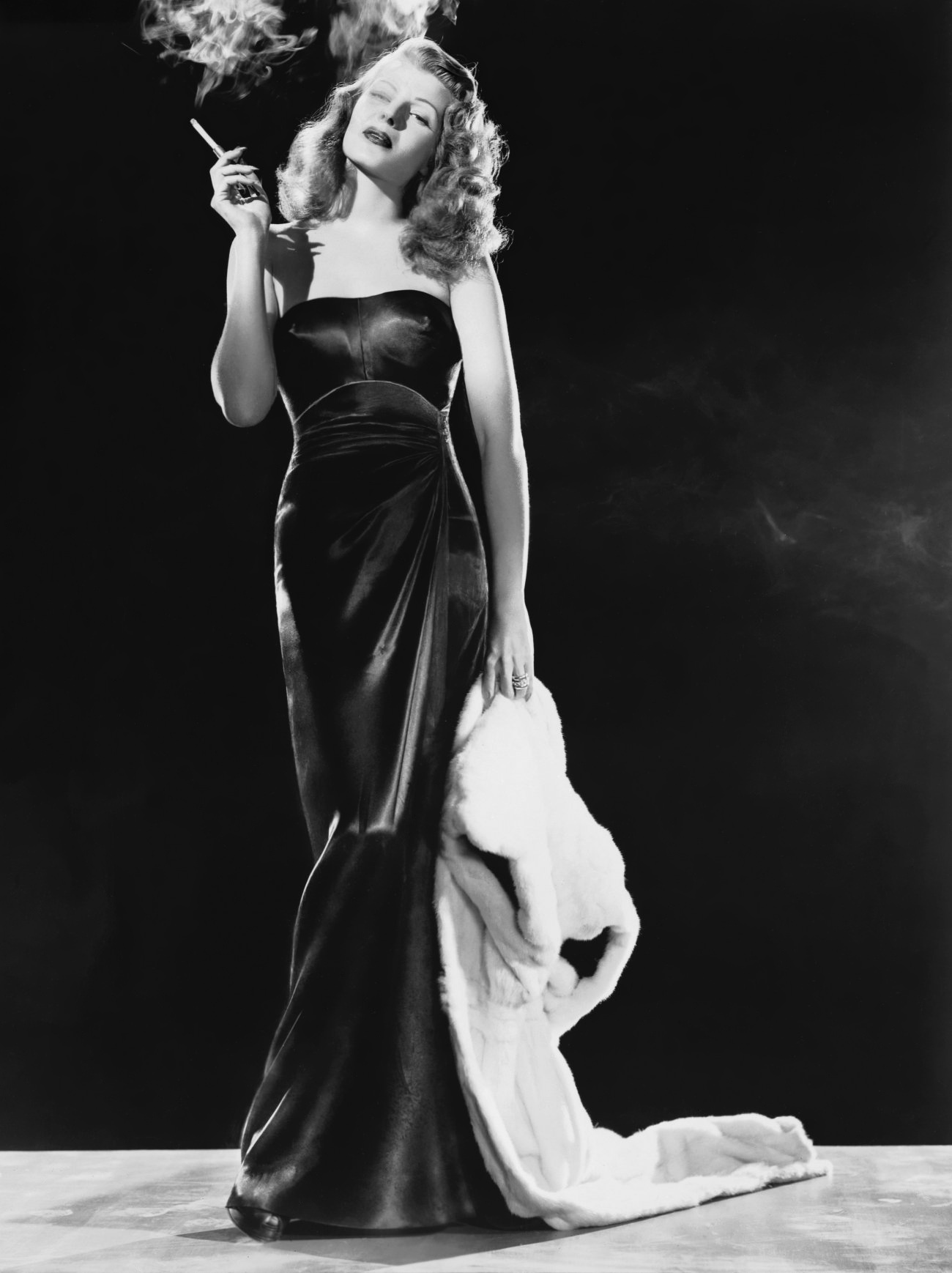
 Barbara Stanwyck, for a period during the 1940’s the highest paid actress in Hollywood, (and woman in the U.S.,) was a self-made woman, if ever there was one. Queen of the film noir, Stanwyck was known for playing tough broads, often the girlfriend of a mobster - Night Nurse, Ball of Fire - or a killer herself - Double Indemnity. Having lost her family at a young age, Stanwyck, born Ruby Stevens, grew up in Brooklyn and got her start on stage at age 13. Often described as ashamed of her lack of education, Stanwyck wasn’t all that ignorant. It was she who fought to have Jack Warner produce The Fountainhead, only to lose the part to Patricia Neal at director King Vidor's insistance. While her role in Double Indemnity with Fred MacMurray and Edward G. Robinson is often considered one of her best performances, my favorite so far has been her lead as Sugarpuss O’Shea in Howard Hawks’ 1941 Ball of Fire, written by Billy Wilder. In it she plays a familiar role, the gangster’s moll, and gets to show off her figure and her sultry voice as a nightclub performer. On the lam to avoid a “subpeeny” from the D.A.’s office, she meets Gary Cooper’s professor Potts, a befuddled doctor of English etymology, looking to complete his slang dictionary. This screwball comedy has Stanwyck first dupe and then fall for Cooper, each teaching the other about a part of life which each had been missing. Barbara steals the movie when she sings along to Gene Krupa, performing his virtuoso Drum Boogie, first with him on drums and her to the band, then him on matches and her sotto voce. Stanwyck was an actress often too big for the roles she played. (Her struggle against the constraints of a reality sometimes too small for our dreams was most passionately portrayed in her 1983 swan song, the Thorn Birds.) In Ball of Fire, a comedy with a plot, we see her as cunning, coy, fun and flustered, and always fully woman. When you watch it, keep in mind that Stanwyck didn’t pull her punches, and that she actually broke actress Kathleen Howard’s jaw in a stunt you’ll see on film. Above, Stanwyck as Stella Dallas, Below, from Ball of Fire, and Stanwyck's last on screen performance in The Thorn Birds - immortal!
