 Orson Welles called her the most exciting woman in the world. There certainly was none with more raw charisma, class and charm. Born in South Carolina in 1927 her career spanned seven decades, television, stage, film, radio and cabaret. She recorded Santa Baby in 1953, starred as Cat Woman on TV's Batman (who else could have upstaged Julie Newmar?) and worked until the end. Born on Benjamin Franklin's birthday, she left on Christmas. Here she is in 1962, singing I Want to be Evil:
Showing posts with label Orson Welles. Show all posts
Showing posts with label Orson Welles. Show all posts
Thursday, December 25, 2008
Eartha Kitt "I Want to be Evil"
Orson Welles called her the most exciting woman in the world. There certainly was none with more raw charisma, class and charm. Born in South Carolina in 1927 her career spanned seven decades, television, stage, film, radio and cabaret. She recorded Santa Baby in 1953, starred as Cat Woman on TV's Batman (who else could have upstaged Julie Newmar?) and worked until the end. Born on Benjamin Franklin's birthday, she left on Christmas. Here she is in 1962, singing I Want to be Evil:
Wednesday, December 17, 2008
"The Lady from Shanghai" Femmes Fatales III
 While it proved unpopular with contemporary audiences (Welles had Hayworth play against type, and had her cut and bleach her trademark red locks) and the studio cut almost an hour from the film, The Lady from Shanghai has fared well since its 1946 release and is now considered among the greats of film noir. Married, but in the midst of a divorce, Orson Welles directed and starred oposite Rita Hayworth in this, their only collaboration. While the story is somewhat disjointed and much is left to the viewer to guess at and fill in, the work is suspenseful and exotic. It keeps one's attention, even if it's not fully amenable to comprehension.
 Merchant marine Michael "Black Irish" O'Hara (Welles) crosses paths with the elegant Elsa (Hayworth) as she rides through central park in a horse-drawn carriage. Moments later O'Hara saves her from an attempted mugging, using a gun she was carrying, but had tossed aside, explaining to him afterwards that she didn't know how to use it. As he escorts her to safely to her car garage, they talk of crime, and he talks of defense attorneys, and how they can get off anyone with enough money. Is the San Francisco lawyer, Arthur Bannister, who just got a man acquitted for shooting his wife five time in the head the world's greatest lawyer, or the worlds greatest criminal? She offers him a job piloting her and her husband's yacht around South America. Thinking he's making a fool of himself, he say's he's not interested. He rips up her card. As he walks off, two men we'll see later in the film step out of the shadows and walk off. The garage attendant identifies Elsa, who has driven off, the rich and beautiful wife – of none other than Arthur Bannister.
 Hayworth is in top form. Her performance in Gilda is unbeatable, but there she plays a jilted lover putting on a tough face. Here she plays the femme fatale, the cold, calculating killer in chic clothing. Having lived in the fleshpots of coastal China, her occupation in such ports as Shanghai going unidentified, Elsa is a woman who "knows how to take care of herself." Part of that taking care of herself is knowing how to appear helpless, to play the victim. The good girl "doesn't smoke." But she knows how to light a cigarette. She "doesn't know how to shoot." But she carries a gun. Michael senses the contradiction. But he too is a man of the world, having killed a man in the Spanish Civil War. He knows that he should know better. But Elsa, or his "Rosalie" as he calls her, is just too enticing a temptation. He knows it's a game, and he figures he'll play.
 The film uses footage of Welles' unreleased South American good-will tour from the War. The story ends in San Francisco where scenes were shot on location. The thrilling final scene in a funhouse is a cinematographic classic. Hayworth is like an exotic animal, a caged white tigress whose grace and quiet beauty belie her underlying bestiality. One can easily see flashes of Sharon Stone's Catherine Tramell from Basic Instinct. Welles' work is a tour de force, even if it is hamfistedly edited by studio censors.
The film's minor flaws actually have one accidental benefit. The viewer will want to watch the film over again to figure out just what he might have missed the first time around. And there is a lot that you will notice if you pay close attention, homages to Hayworth's Gilda, recurring themes, a cameo of Errol Flynn. This film is fascinating, and you will want to watch it again and again. I have.
This film should be rented or made a part of your permanent library. It is available from Netflix. Here is a highlight from YouTube:
Here are parts two (lafrshaa) and three (lafrshab).
Read Femmes Fatales Part I and Part II
Friday, December 12, 2008
Orson Welles "Touch of Evil"
 If you are a fan of one of the best shows on TV, House, M.D., with Hugh Laurie, you have probably seen the poster for the Orson Welles film, Touch of Evil, hanging in the office of Dr. Gregory House's best friend, oncologist James Wilson. If you haven't seen House, then you should, and you can either rent or buy the series to watch it from the beginning (recommended) or jump in now and watch a recent episode here at Hulu.com. Why the poster of Touch of Evil? Perhaps it's just a classic film that the writers thought would give Wilson depth. Or maybe there is an implied comparison between House, a curmudgeonly cynic who walks with a cane, and Orson Welles' cane-using Hank Quinlan? But Welles' captain Quinlan has moved beyond cynicism into taking law and life into his own hands. (Well, one could argue that Gregory House has done that too, but he has so far not framed anyone for his own murders.) In any case, if you haven't yet watched the film, this too is a classic you should not miss.
 Directed by Welles, Touch of Evil, 1958, is one of the most popular masterpieces of film noir. The movie stars Charlton Heston and Janet Leigh, as well as Welles, and features appearances by Joseph Cotten, Dennis Weaver, Mercedes McCambridge, Marlene Dietrich and Zsa Zsa Gabor. The opening scene, an uninterrupted 3 1/2 minute long single-cut shot from a crane depicting a border crossing that literally ends with a bang, is a classic Wellesian cinematographic accomplishment.
  Like many of Welles' films, such as the difficult The Magnificent Ambersons, the work was drastically cut by the studio without his consent before its release. But Welles did write a long memo to Universal regarding his intentions for the production. This memo survived, and, in 1998, after a legal battle with his estate, a restoration based on archival material was printed which remains as faithful as possible to his intentions with the surviving footage. The film does seem to shift abruptly at some points, but there is much less confusion than in Welles' other continuity-challenged film noir masterpiece, The Lady From Shanghai. Rent or buy the 1998 'director's cut' today.
Here is the famous opening seen from YouTube:
Saturday, August 23, 2008
"Hate Can Be a Very Exciting Emotion"
Quick, which iconic 1940's film noir features a thrid-world nightclub owner, Nazis, a love affair gone wrong, a fateful airplane trip and an iconic theme song? If you said Casablanca, then you should have said Gilda, the best film of the 1940's, the one where the hero does not achieve greatness through sacrifice.
 Directed by Charles Vidor, Gilda stars Glenn Ford as Johnny Farrell, a handsome, streetwise adventurer and romantic lead who "makes his own luck." Having just ended a relationship, our hero moves to Buenos Aires as the war in Europe is coming to a close. He meets Ballin Mundson, a German expatriate with a dueling scar, who rescues him from a mugging in the opening scene. The classy and witty dialog and reparté is reminiscent of such films as the screwball comedy His Girl Friday, and the romantic drama To Have and Have Not. Originally cast for Humphrey Bogart who turned the role down, Glenn Ford's Johnny becomes the right hand man at Mundson's illegal Buenos Aires casino. Mundson, driven and unhappy, goes away leaving Johnny in charge. He returns, grinning like a fool, wed to Rita Hayworth's glorious Gilda, one of the most famous screen roles ever played. Unbeknownst to Mundson, Johnny and Gilda have a past. The three toast "Disaster to the wench that did our Johnny wrong," and murder ensues. The film is well plotted, and slyly written. Hayworth is at her best, singing in the nightclub, and, by removing just one glove, performing perhaps the most seductive striptease in cinematic history. I first saw this movie a year ago, and have watched it more than six times since. It cannot recommend it more highly. Hayworth also shines in The Lady from Shanghai, written and directed by, and starring Orson Welles, who was married to Hayworth at the time. Sadly, Hayworth found it impossible to live up to the fantasy ideal of Gilda in her life off stage. After several failed marriages, she complained that men "went to bed with Gilda, and woke up with me."
What all the fuss is about:
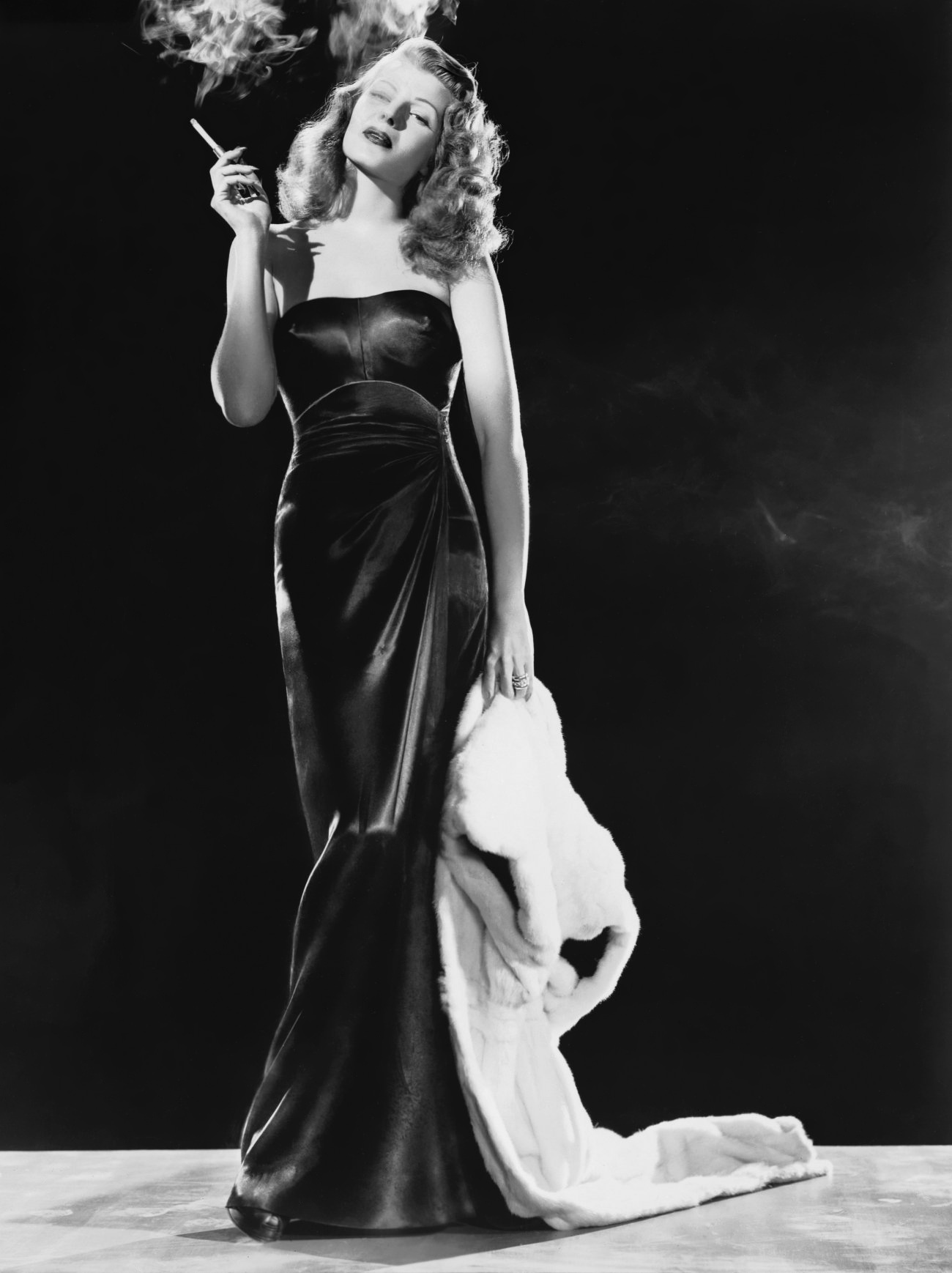 Directed by Charles Vidor, Gilda stars Glenn Ford as Johnny Farrell, a handsome, streetwise adventurer and romantic lead who "makes his own luck." Having just ended a relationship, our hero moves to Buenos Aires as the war in Europe is coming to a close. He meets Ballin Mundson, a German expatriate with a dueling scar, who rescues him from a mugging in the opening scene. The classy and witty dialog and reparté is reminiscent of such films as the screwball comedy His Girl Friday, and the romantic drama To Have and Have Not. Originally cast for Humphrey Bogart who turned the role down, Glenn Ford's Johnny becomes the right hand man at Mundson's illegal Buenos Aires casino. Mundson, driven and unhappy, goes away leaving Johnny in charge. He returns, grinning like a fool, wed to Rita Hayworth's glorious Gilda, one of the most famous screen roles ever played. Unbeknownst to Mundson, Johnny and Gilda have a past. The three toast "Disaster to the wench that did our Johnny wrong," and murder ensues. The film is well plotted, and slyly written. Hayworth is at her best, singing in the nightclub, and, by removing just one glove, performing perhaps the most seductive striptease in cinematic history. I first saw this movie a year ago, and have watched it more than six times since. It cannot recommend it more highly. Hayworth also shines in The Lady from Shanghai, written and directed by, and starring Orson Welles, who was married to Hayworth at the time. Sadly, Hayworth found it impossible to live up to the fantasy ideal of Gilda in her life off stage. After several failed marriages, she complained that men "went to bed with Gilda, and woke up with me."
What all the fuss is about:
Monday, July 28, 2008
Download Orson Welles' Mecury Theater for Free
 Orson Welles' Mercury Theater Company (renamed the Campbell Theater Company after Campbell Soup took up its sponsorship) produced the infamous "War of The Worlds" 1938 broadcast, and dozens more, which are available for free here: http://www.mercurytheatre.info/
The following titles are available, about one hour each:
Dracula
Treasure Island
The 39 Steps
Three Short Stories: I'm a Fool, The Open Window, and My Little Boy
Abraham Lincoln
The Affairs of Anatol
The Count of Monte Cristo
The Man Who Was Thursday
The Immortal Sherlock Holmes
Hell on Ice
Seventeen
Around the World in 80 Days
The War of the Worlds
Heart of Darkness / Life with Father
A Passenger to Bali
The Pickwick Papers
Rebecca
A Christmas Carol
Counselor-at-Law
Mutiny on the Bounty
I Lost My Girlish Laughter
Arrowsmith
The Green Goddess
The Glass Key
Beau Geste
Showboat
The Patriot
Private Lives
Wickford Point
Our Town
The Bad Man
Things We Have
Victoria Regina
Peter Ibbetson
Ah, Wilderness
What Every Woman Knows
The Count of Monte Cristo
Algier
Liliom
The Magnificent Ambersons
The Hurricane
The Murder of Roger Ackroyd
The Garden of Allah
Dodsworth
Lost Horizon
Venessa
There's Always a Woman
A Christmas Carol
Vanity Fair
Theodora Goes Wild
The Citadel
It Happened One Night
Mr. Deeds Goes to Town
Dinner at Eight
Only Angels Have Wings
Rabble in Arms
Craig's Wife
Huckleberry Finn
June Moon
Subscribe to:
Posts (Atom)

