Johnny Twennies, columnist for the New York Sun Telegram, wears a fedora, sends telegrams, whistles for taxis, and he thinks his girlfriend is just swell. Of course, after 27 dates Samantha's still wondering when she's going to get kissed. Johnny is a man of his times. His times are the late 1920's, even though he's living in 1990's New York. Cheerfully oblivious to the coarse, cynical and sexually liberated modern world, Johnny refuse to see the ugliness or surrender to the unhappiness around him. He woos his girl, does his job, teaches the bullies a lesson, shows the mob who's boss, and shows himself a hero, all without breaking a sweat.
This film is a welcome treat. The writing is witty. The story works just fine as either farce or straight up. Double entendres and screwball comedy abound. Frank Gorshin (TV Batman's The Riddler) and famed Manhattan night club performer Bobby Short play small roles. The black and white cinematography lends to the atmosphere and allows of certain artful touches. The period piece musical scenes are delightful. This film is a cult favorite, and bears repeated viewing. It should have won its star and co-writer Gibson Frazier and its director an co-writer Adam Abraham an award. It's a great date movie. Rent it today. Here is a trailer from YouTube:
After it was hit by a car on a freeway in Santiago, Chile, another stray dog braved the traffic and dragged the mortally injured dog to the side of the road. Chileans have called to adopt the rescuing canine, but it ran off when work crews arived. Watch the video with commentary by Cesar Millan, The Dog Whisperer, in English:
There are some drugs so strong that daily usage is contraindicated. I don't know what side-effects, other than tears of joy, Celia Cruz's voice may cause, but if the issue were potency, I'm sure the FDA would want to have her banned. Celia Cruz, 1925-2003, was, according to Wikipedia, (and here one cannot doubt them) "the most influential female figure in the history of Cuban music." Her clear and powerful voice had few rivals, and her sense of joy was incomparable.
Cruz's career had just begun to take off when the communists rose to power in Cuba. In 1960 she left the country, moving to New Jersey and becoming a US citizen. She recorded some 60 albums. She had a famous long term collaboration with Latin drummer Tito Puente. She performed constantly until shortly before her death from cancer. She was buried in Woodlawn Cemetary in the Bronx with soil she had saved from a visit to Guantánamo.
My favorite song by "La Celia" and her most well known among Americans is Guantanamera which means "The Girl from Guantánamo." The song is the unofficial anthem of the island. One of the most beautiful ballads of the 20th Century, it was composed in 1929 by Joselíto Fernández. It was inspired when Fernandez was spurned by a pretty girlk at whom he had made a pass. Over the years the lyrics have evolved to have a more topical meaning. The music is plaintive yet joyful and defiant.
The first verse is:
Yo soy un hombre sincero De donde crece la palma Y antes de morirme quiero Echar mis versos del alma Guantanamera, guajira, Guantanamera
which translates as:
I am a sincere man From where the palm tree grows And before dying I want To share the verses of my soul.
You can see the full lyrics here. The simple melody performed with steel drums and flute is one of the purest and transporting of sounds. While the song may make you cry, it should be with tears of joy. Here is one of the better performances by Cruz available on YouTube:
Thrash Metal is a music genre not known for its subtlty. The Texas heavy metal band Pantera, 1981-2003, was perhaps the epitome of the thrash metal style. With its pounding beats and screaming double-time guitar riffs, thrash is meant for the mosh pit, not so much a form of slam "dancing" as a militaristic pagan ritual that entrains the mind and evokes an adrenaline and testosterone pumped berserker rage.
The berserker is known to us primarily from Norse history and anthropology. Members of the bear cult, such men danced in bearskins, and showed the bears sometimes placid, sometimes ferocious nature. The phenomenon of the sometimes warrior, the taciturn male who might spend months in becalmed isolation, hunting or fishing in the frozen north, only to release his fury in a violent fit is known throughout the Arctic among tribes as far east as the Eskimo. In prehistoric times the herdsman and hunter gatherers of the north led a hard life, fighting against the elements with wits and patience. War was seldom and costly. But when the need came to defend oneself, the stolid laborer could transform into the berserker. This was originally brought on by stress, but often came to be institutionalized, encouraged by the use of Amanita mushrooms or by cultic dances. The Byzantines remarked upon a "Gothic dance" performed by the emperor's Varangian guard. An animalistic mode of mind meant for individual combat, where a man had to quickly overcome his inhibitions to meet a sudden threat, had evolved on the edge of civilization to a cult seen as useful to the military leader, but also a threat, a double-edged sword that was eventually outlawed as the berserker peoples were Christianized.
The berserker phenomenon is obviously a relic of our animalistic past. As a fighting form, the mad warrior who fights in the nude without regard to personal safety will not prevail against the calculating and disciplined troops of Rome or the US Marines. But whether we see it in the movie Fight Club or in the thrash metal mosh pit, the berserker phenomenon is still a part of the male nature. Initiating physical violence against the innocent may be wrong, but boxing and wrestling and the physical contact of American football feels good. And if it can be expressed in a sublimated form, it can be a thrilling and even addictive experience.
Slam dancing is one such sublimation. The "moshers" or slam dancers assemble in an enclosed area tightly packed mostly with young men. Suitable music is played with a beat conducive to bouncing up and down on two feet. The dancers bounce off each other and the walls, building into a frenzy. People swing their arms and twirl about like dervishes or ball-bearings in a shaken can. The beat of the music induces a trance. The release of adrenaline induces a state of euphoria. There is physical violence although not individual malice. People do get punched by flailing fists. There are falls and bruises and broken bones, and some have broken their necks.
Stage divers leap from the stage onto the awaiting arms of the crowd, who buoy the divers up and pass them along in what looks like a parody of a trust-building exercise at a motivational camp. Yet this is the real thing, not a parody. Evereyone is here voluntarily, enjoying the same music, engaging in what is not an act of malice but more a team sport or a pagan ritual. Afterwards there are smiles and sweating bodies that remind one of an athletic meet, not a gang fight. Young men have enjoyed their animal natures in a freely organized forum with a joyous physical lust that borders on the erotic. The psychic power manifested here is certainly of a kind with that which in malevolent circumstance and under the control of a demagogue will become a Nazi or Jihadist or Kamikaze rally. Used properly, the mosh pit is no more questionable than the shooting range or the boxing ring. It is not the expression, but the use and purpose that determines the morality of the action.
Here is Pantera, perhaps the premier thrash metal group of the 1990's, performing "Walk" in their tour with White Zombie. You can see stage divers in the front of the crowd, but the slam dancers are back from the stage by about 30 feet.
Born in Toulouse, France, in 1882, Edmund Dulac was a prolific illustrator in the Art Nouveau style. He drew hundreds of illustrations for delux edition storybooks. During WWI he illustrated relief books to support the French and Belgian causes. After the war and a change in publishing away from expensive editions he designed stamps and currency, did portraiture and commercial design and even some set design for Orson Welles' Mercury Theater.
Dulac originally studied law, which he found boring. His dramatic artwork is anything but boring. His use of complex natural, especially floral designs is typical of the Art Nouveau style. Today we would recognize the fractal complexity of such patterns. Typical motifs were nature scenes from fairy tales or the beautiful garden scene for the poetry of Omar Khayyam.
His use of vivid color and dramatic themes and dynamic compositions is stylistically romantic. But he avoids contemporary imagery. He draws no battles, no buildings, no modern achievements. His romance is of a different world or a distant age. Yet it is the romance of human drama - not the folksy corniness of Norman Rockwell nor the landscapes of Maxfield Parrish. His work compares favorably with that of Louis Comfort Tiffany for its luminance and that of René Lalique for its grace.
You can see many of Dulac's prints for sale on line. Artsy Craftsy has some very nice images. There is an article on Dulac at Wikipedia. They also have a gallery of some of his works, but the colors are washed out, so if you like the image you would do well to find a better reproduction of it with a web search. You can also use your browser to view the images here in full size.
Jerry J., who goes by the web name Ergo Sum, is one of India's bright young urban professionals with a positive sense of life and a pro-reason, pro-Western, pro-happiness attitude. A Mumbai (Bombay) resident, it is his chosen lifestyle that certain subhumans chose to attack recently. It is sad and ironic when terrorist barbarians know better than "civilized" Westerners what India has to be proud of.
He has invited me to reprint one of his posts from his blog and website, Leitmotif (http://ergosum.wordpress.com/). Leitmotif is a humanist website, not just an Indian one. Jerry's interests are wide ranging, and his clarity and writing style are exemplary. There are many things of interest, and I recommend you stop by and check him out. Here is a favorite post of mine "Flamenco Passion":
Flamenco Passion
The flamenco dance is like an Ayn Rand novel in rhythmic action: hard-hitting, sharp, precise, thunderous, passionate, Flamenco Dancergripping, poised, and proud. Since the day I first witnessed a flamenco dance performance in concert, I have never forgotten the visceral experience of exaltation I had nor have I come to regard any other dance form as rivaling this one. The flamenco portrays man at his best, proudest, and most passionate stature. It depicts a committment to clarity and precision in movement. Its expressions are fierce and its colors, vivid.
The flamenco can be a fiery celebration of life, or love, or lust, or power, or some intense emotion. Its artistic selectivity is focused on the stark elements of human actions and emotions: the expressions are not vapid or one of ambivalence. The dancer’s expressions are focused, sharp, intense, often proudly disdainful, also exuberant, and radiant. The dancer moves with a loud, deliberate THUD, as if readying for battle. The subtleties of its movements are expertly weaved into the stark contrasts in its execution.
For me, after having watched a flamenco concert, I feel a new, revitalized, surge of energy–a nourishment of my soul, a renewed committment to the pursuit of my happiness in this life. I begin to walk upright with my neck slightly raised; my poise exudes more confidence; my stance implies purposeful action; my gaze reveals some worthy goal.
This is what Romantic art does. In The Romantic Manifesto, Ayn Rand aptly describes this important function of art: Since a rational man’s ambition is unlimited, since his pursuit and achievement of values is a lifelong process… he needs a moment, an hour or some period of time in which he can experience the sense of his completed task, the sense of living in a universe where his values have been successfully achieved. It is like a moment of rest, a moment to gain fuel to move farther. Art gives him that fuel; the pleasure of contemplating the objectified reality of one’s own sense of life is the pleasure of feeling what it would be like to live in one’s ideal world. The fuel is not a theoretical principle but the fact of experiencing a moment of metaphysical joy – a moment of love for existence.
[The image of the dancer is copyrighted to Tim Kahane and was obtained by me from this Flickr link.]
There is a conjunction of Venus, Jupiter and the moon tonight, just after sunset. If you consider that Jupiter, Venus and the Earth are all in the same plane focused on the sun, you can actually see the plane of the solar system. The moon is at a tilt and is outside the plane. (Draw a line from the crescent moon to the sun, just over the horizon, and you will see this.) If you imagine in your head the plane of the solar system and the moon lying outside that plane you will form a three dimensional image of the solar system. This is a unique opportunity to the planets not just as dots on a flat sky, but actually to "see" the solar system from a god's eye view, and a good time to dust off your digital camera.
Radicals for Happiness focuses on matters which bring people joy of all kinds, from the light-hearted to the profound. The purpose of this site is to share things of value. If a post makes you laugh, smile, think or shed a tear, it has done its job. Please let us know what you like with your comments!
What do readers say?
Ted, I can't tell you what a favor you've done me. ... I discovered your link to Orson Welles' old radio series, Mercury Theater, and I'm in the process of delightedly dowloading all of the shows. When I was a child, I insisted on getting permission from my parents to stay up Sunday evenings, in order to listen to Mercury Theater; I was entranced by Welles' wonderful plays and by his magnificent speaking voice. That Sunday evening hour was one of the highlights of my week, which nothing could have persuaded me to miss. And now I have it back. Many, many thanks.
 Johnny Twennies, columnist for the New York Sun Telegram, wears a fedora, sends telegrams, whistles for taxis, and he thinks his girlfriend is just swell. Of course, after 27 dates Samantha's still wondering when she's going to get kissed. Johnny is a man of his times. His times are the late 1920's, even though he's living in 1990's New York. Cheerfully oblivious to the coarse, cynical and sexually liberated modern world, Johnny refuse to see the ugliness or surrender to the unhappiness around him. He woos his girl, does his job, teaches the bullies a lesson, shows the mob who's boss, and shows himself a hero, all without breaking a sweat.

 After it was hit by a car on a freeway in Santiago, Chile, another stray dog braved the traffic and dragged the mortally injured dog to the side of the road. Chileans have called to adopt the rescuing canine, but it ran off when work crews arived. Watch the video with commentary by Cesar Millan, The Dog Whisperer, in English:
 There are some drugs so strong that daily usage is contraindicated. I don't know what side-effects, other than tears of joy, Celia Cruz's voice may cause, but if the issue were potency, I'm sure the FDA would want to have her banned. Celia Cruz, 1925-2003, was, according to
  The first verse is:
 Thrash Metal is a music genre not known for its subtlty. The Texas heavy metal band Pantera, 1981-2003, was perhaps the epitome of the thrash metal style. With its pounding beats and screaming double-time guitar riffs, thrash is meant for the mosh pit, not so much a form of slam "dancing" as a militaristic pagan ritual that entrains the mind and evokes an adrenaline and testosterone pumped berserker rage.
 The berserker is known to us primarily from Norse history and anthropology. Members of the bear cult, such men danced in bearskins, and showed the bears sometimes placid, sometimes ferocious nature. The phenomenon of the sometimes warrior, the taciturn male who might spend months in becalmed isolation, hunting or fishing in the frozen north, only to release his fury in a violent fit is known throughout the Arctic among tribes as far east as the Eskimo. In prehistoric times the herdsman and hunter gatherers of the north led a hard life, fighting against the elements with wits and patience. War was seldom and costly. But when the need came to defend oneself, the stolid laborer could transform into the berserker. This was originally brought on by stress, but often came to be institutionalized, encouraged by the use of Amanita mushrooms or by cultic dances. The Byzantines remarked upon a "Gothic dance" performed by the emperor's Varangian guard. An animalistic mode of mind meant for individual combat, where a man had to quickly overcome his inhibitions to meet a sudden threat, had evolved on the edge of civilization to a cult seen as useful to the military leader, but also a threat, a double-edged sword that was eventually outlawed as the berserker peoples were Christianized.
 The berserker phenomenon is obviously a relic of our animalistic past. As a fighting form, the mad warrior who fights in the nude without regard to personal safety will not prevail against the calculating and disciplined troops of Rome or the US Marines. But whether we see it in the movie Fight Club or in the thrash metal mosh pit, the berserker phenomenon is still a part of the male nature. Initiating physical violence against the innocent may be wrong, but boxing and wrestling and the physical contact of American football feels good. And if it can be expressed in a sublimated form, it can be a thrilling and even addictive experience.

 Born in Toulouse, France, in 1882,
  Dulac originally studied law, which he found boring. His dramatic artwork is anything but boring. His use of complex natural, especially floral designs is typical of the Art Nouveau style. Today we would recognize the fractal complexity of such patterns. Typical motifs were nature scenes from fairy tales or the beautiful garden scene for the poetry of Omar Khayyam.
  His use of vivid color and dramatic themes and dynamic compositions is stylistically romantic. But he avoids contemporary imagery. He draws no battles, no buildings, no modern achievements. His romance is of a different world or a distant age. Yet it is the romance of human drama - not the folksy corniness of Norman Rockwell nor the landscapes of Maxfield Parrish. His work compares favorably with that of
  You can see many of Dulac's prints for sale on line.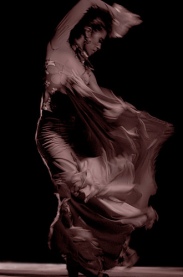
 There is a conjunction of Venus, Jupiter and the moon tonight, just after sunset. If you consider that Jupiter, Venus and the Earth are all in the same plane focused on the sun, you can actually see the plane of the solar system. The moon is at a tilt and is outside the plane. (Draw a line from the crescent moon to the sun, just over the horizon, and you will see this.) If you imagine in your head the plane of the solar system and the moon lying outside that plane you will form a three dimensional image of the solar system. This is a unique opportunity to the planets not just as dots on a flat sky, but actually to "see" the solar system from a god's eye view, and a good time to dust off your digital camera.
